Swingarm1
Date: 20/7/2020
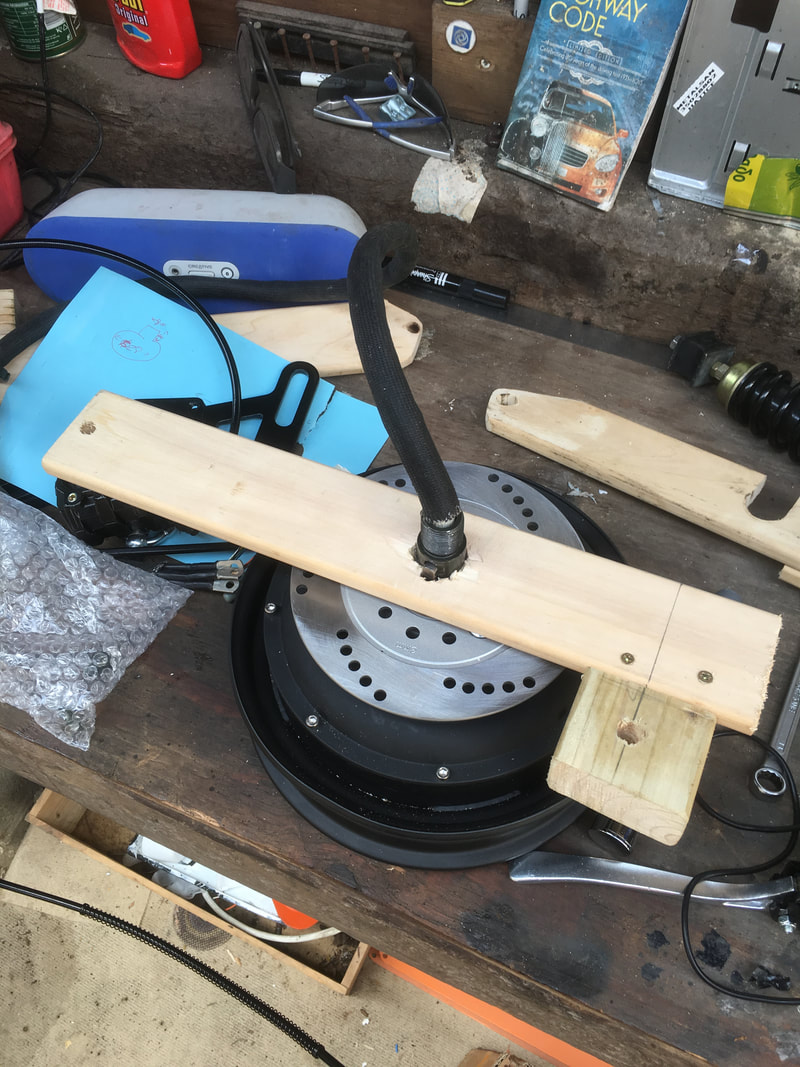
So now that I have the motor, I have been looking at designing my swingarm. The main problem is that the wheel is still rather large the whole way out, so the shock absorber needs to be connected somewhat up and away from the wheel. This is a fairly easy fix, but this will mean that I need to locate a slightly shorter shock.
I have Fabbed it up with bits of wood, to see if it will work, and it looks like it should be fine! Basic Swingarm version 1.0 is complete!
Battery issues
Date: 11/7/2020
So I am still struggling to find a battery that can output at the Amps that I need it to.
The motor claims it needs 45A continuous, lets add say 20A to that for the BOS and maybe 5A more for the controller to run. That means we need a battery capable for giving us 70A continuous. This is somewhat a problem as it seems most comercially available batteries only really can do 50ACC.
I will probably need a custom battery then, and that means either I have to learn how to build a battery - or I hire someone else to build a battery for me. Sadly all of the battery builders I can find online never reply to my emails, so I am somewhat unsure what to do now.
I have found these high capacity cells, which claim up to 3C (i.e. they can discharge themselves at three times their capacity - in this case 120A CC). Im not sure if I would need to BMS these together or not - as I can specify high/low voltage with my controller. That would, however mean adjusting my wiring diagram to have it charge through my controller somehow.....
6V AC to 12V DC
Date: 5/7/2020
So, electronics problem. The current system for electronics is, I think (I forgot to test this before removing the engine), a 6 volt AC system. This is why the lights flicker seemly with the revs on the engine. The current coming from the stator on the engine is alternating, not direct. Therefore, when I tried to plug in a 6V battery this morning nothing happened.
After conversion I will be able to supple a content 12V DC current to the onboard system (what is sometimes called the Balance of System) via a 48V/12V DC/DC converter. (I think I will probably plump for this one). So, before I can do that I need to rewire everything so that it is capable of handling not only a higher-than-usual voltage but also direct not alternating current.
The other consideration is that this is the perfect time to put indicators on the thing. BUT - I can't seem to find any indicators that are subtle or hidden or look good. I know the german 150s had big ones on the outside of the saddlebags (I am not sure what they're actually called), but I think they look horrible (see photo)! I think, for the moment, I will leave the indicators off. If I decide that I want them at a later point, I think it might be easy to simply remove the battery and rewire!
The Bike!
Date: 2/7/2020
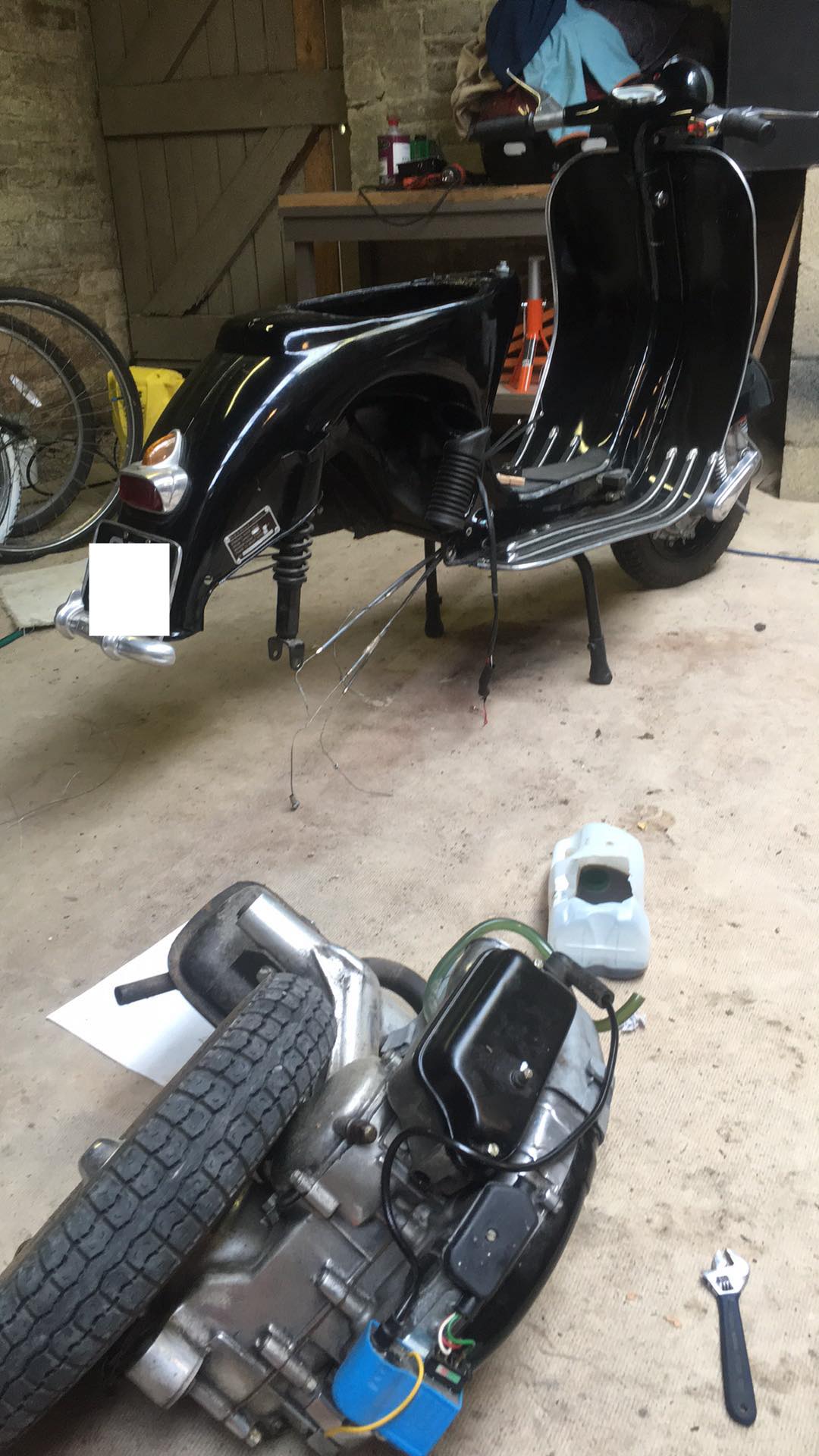
Finally, I have the bike so now the real work can begin!
Originally I lost the eBay bidding for the bike, but luckily (for me) the winner turned out not to be able to afford the thing, so I got it for a bargain. I did have to drive to Essex, but I'll probably get over that with a lot of therapy...
Batteries
Date: 15/6/2020
Batteries are more expensive than you think. Also how you wire them up is apparently important!!!
According to 300mpg.org volts \~\= speed. The advantage of converting a scooter and not a big bike, is that no one is expecting very much speed, so you can get away with a lower-voltage system - saving you cash.
Even once you have decided your voltage requirements there are a whole load of other things to think about:
1 Lead Acid or Li Ion?
Lead acid has the advantage of being cheaper, but the major disadvantages of being bigger, heavier and holds less power - oh and also if you drop the bike you’ll end up with acid all over your shoes. Li Ion is more expensive, but can hold more charge per cm^2, and will not cause your feet to melt when you drop the bike.
2 BMS
No one really talks about BMS’s, because it reveals a secret about batteries that battery companies have been trying to contain for years. Big batteries are actually just loads of small batteries put together! As far as I can tell, without letting the battery-illuminati know that I am on their case, most big batteries are just clumps of 18650 batteries wired in series and parallel to provide the current voltage and amp hour output (side note: amp hour, or Ah, is how much charge a battery can provide for how long. i.e an 80Ah battery can give 80A for one our, or 1A or 80 hours; or any combination therein). A BMS is a little circuit board that ensures that each of the little 18650 cells is equally charged, and that the power is not being drained from one faster than any other. A must-have for any battery of cells then… However, it is not clear that any battery pack online is equipped with a BMS - some of them say "BMS inside” or words to that effect, but that only makes it more suspicious when they don’t have that on the label….
3 Building batteries
Now that I have been inducted into the battery sanctum, it turns out that you can build your own battery packs to suit whatever specs you need to do that. This essentially involves spot welding conductive metal between the cells to join them in series/parallel. I think this is a really cool idea, but the idea of working with such big voltages scares me, so I think safer to rely on a trained professional to build my batteries for me. It does, however, mean that I can specify any size / shape battery that I wish - rather than relying on big clunky square ones.
Motors
Date: 8/6/2020
Right, so I am right - what a surprise!
QS motors - who apparently are fairly well known for their hub motors will sell me an electric motor for about $250 dollars. The motor controller (which I am still not really sure what it does - surely just plug the motor into the batteries and off you go? Add a resistor operated by the throttle if you want to control your speed?) costs more than the motor (somehow!), and postage is about $150. so about $700 for the whole kit (not including the batteries). Unless the batteries and their LED headlight cost £3000, then Im going to tip the police off about an ongoing incident of daylight robbery…
I think I will plump for a 3Kw motor. this does not sound like a lot, given that my motorbike has 35Kw and is still underpowered. However, electric Kw are different from petrol Kw. The torque is always and instantly there, no waiting around or changing gear for that power. I am fairly sure that 3Kw is all I need as I am only aiming for a top speed of about 30mph. It just needs enough power to not be crushed by a bus when the driver inevitably does not see you on it! Its either that or paint it bright orange - and im considering that! Helpfully Retrospective publish their motor’s stats as a 3Kw motor, and they claim it is of similar power output to that of a 125cc engine. So I feel fairly secure in that.
The choice to go with a hub motor is also obvious given the choice of bike: the vespa is not chain driven, the engine sits on the swingarm and provides direct power (via the gearbox) to the wheel. Going with a central motor would mean building a whole new drive system for the vespa. I have seen a post by someone who removed the engine and bolted an electric motor where it used to be, which would retain the gearbox and drive chain, but this seems unnecessarily complex.
The Plan
Date: 1/6/2020
A company named Retrospective Scooters sells a vespa E-conversion kit on their website for £3500. Whenever they get an order they must be popping the champagne and celebrating. My maths would suggest that you can do the whole thing (and potentially get better stats than their claimed ones) for near enough half the price. Their kit (in the Photo) basically comprises of an electric hub motor, a motor controller, a battery and some wires. How can they charge £3500 for that?!!?!
So, The Plan:
Build an electric vespa for less money than the kits you can buy off the internet.